
Explore marine species from tropical and temperate waters and learn a few facts about their ecology. Tap any picture to see it in full size.
Temperate waters
Kelp forests and rocky reefs of the eastern Pacific
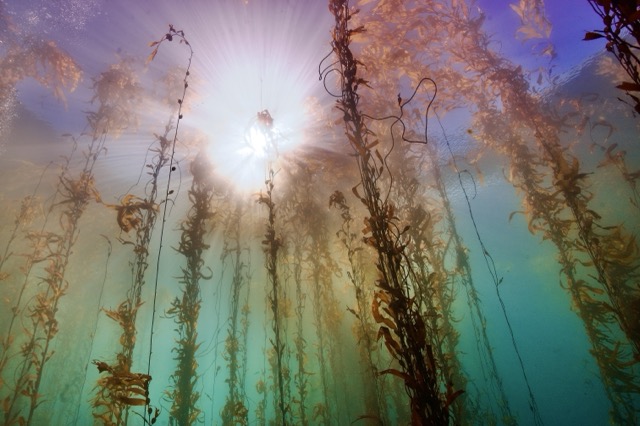
Giant kelp
Macrocystis pyrifera
Read more
Giant kelp forms dense underwater forests along temperate coastlines and is one of the fastest-growing organisms on Earth. Its long, buoyant fronds can reach from the seafloor to the ocean surface, creating a complex three-dimensional habitat for fish, invertebrates, marine mammals, and seabirds. However, marine heatwaves, intense grazing by sea urchins, pollution, and the loss of predators can rapidly reduce these forests and shift them toward persistent urchin barrens.

Purple sea urchin
Strongylocentrotus purpuratus
Read more
Purple sea urchins are important grazers in eastern Pacific kelp forests, but when predators decline and warming weakens kelp, they can transform forests into urchin barrens. In these food-poor habitats, the urchins survive by reducing their metabolism and resorbing their own gonadal tissue for energy. Even after their gonads have greatly diminished, they can remain alive and graze newly emerging kelp, helping to prevent the forest from recovering.

California sheephead
Semicossyphus pulcher
Read more
The California sheephead is a large wrasse found on rocky reefs and in kelp forests from California to the Gulf of California. Using powerful jaws and prominent teeth, it feeds on hard-shelled animals such as sea urchins, crabs, and mollusks, helping regulate reef grazers. California sheephead begin life as females, and some later transition into males, developing a black head and tail, a reddish body, and a prominent forehead. This life history also makes their populations sensitive to fishing that selectively removes the largest individuals.

Garibaldi
Hypsypops rubicundus
Read more
The Garibaldi is an unmistakable bright-orange damselfish found on rocky reefs and in kelp forests along California and Baja California. Known for their bold territorial behavior, males carefully guard nests and developing eggs. Garibaldi are remarkably long-lived, with individuals recorded at up to 57 years old, and are fully protected from take in California.

Sea otter
Enhydra lutris
Read more
Sea otters are the classic keystone predator of North Pacific kelp forests. Unlike most marine mammals they have no blubber and stay warm with the densest fur of any animal. By eating sea urchins they can help kelp forests return, although how quickly that happens depends strongly on local conditions.
Photo: Mike Baird, Wikimedia Commons, CC BY 2.0


California spiny lobster
Panulirus interruptus
Read more
Spiny lobsters have no large claws. Instead they defend themselves with long, spiny antennae and hide in reef crevices by day. At night they forage for sea urchins, snails and mussels, which makes them an important predator for keeping kelp forest grazers in check. They support valuable fisheries in California and Baja California.
Photo: NOAA, Wikimedia Commons, Public domain
.jpg)

Giant sea bass
Stereolepis gigas
Read more
The giant sea bass is one of the largest bony fishes on the reefs of the northeastern Pacific and can grow over two meters long. It can live for more than 70 years and reaches maturity late, which made it highly vulnerable to overfishing in the twentieth century. Since protections were introduced in California, divers are seeing these gentle giants more often again.
Photo: Donald Davesne, Wikimedia Commons, CC BY 4.0


Sunflower sea star
Pycnopodia helianthoides
Read more
With up to 24 arms and a span of up to a meter, the sunflower sea star is one of the largest and fastest sea stars in the world and a major predator of sea urchins. Since 2013, sea star wasting disease has killed more than 90 percent of its population, and in 2020 it was listed as Critically Endangered by the IUCN.
Photo: Ed Bowlby, NOAA, Wikimedia Commons, Public domain


Kelp bass
Paralabrax clathratus
Read more
Kelp bass, also called calico bass, are ambush predators that hover among kelp fronds waiting for small fish and crustaceans. They grow slowly and can live for more than 30 years, so they are sensitive to fishing pressure. They are one of the most common predatory fishes in the kelp forests of southern California and northern Baja California.
Photo: Brian Gratwicke, Wikimedia Commons, CC BY 2.0

Tropical waters
Coral reefs of the Caribbean and beyond

Branching anemone
Lebrunia neglecta
Read more
The branching anemone is distinguished by six highly branched pseudotentacles that resemble algae or soft corals and help it blend into the reef. Its true tentacles are largely concealed beneath these structures and contain stinging cells used to capture and guide prey toward the mouth. When disturbed, the anemone withdraws deeper into its rocky shelter, while the pseudotentacles may remain visible.

American whitespotted filefish
Cantherhines macrocerus
Read more
The American whitespotted filefish has a strong, prominent spine on its back that can be raised when the fish feels threatened. This spine can be locked upright, allowing the filefish to wedge itself securely into reef crevices. The mechanism helps protect it from predators by making the fish difficult to remove from its shelter. Reaching up to about 40 cm in length, it feeds mainly on soft corals, hydroids, sponges, algae, and other reef-dwelling organisms.

Spotfin frogfish
Abantennarius nummifer
Read more
The spotfin frogfish is a well-camouflaged ambush predator. Its modified first dorsal spine functions like a fishing rod, with a small fleshy lure that it moves in front of its large mouth to attract unsuspecting prey. Once a fish or crustacean comes within reach, the frogfish rapidly expands its mouth and swallows it. Its rounded body, textured skin, and slow movement help it blend into reefs and remain almost invisible while hunting.

Spotted eagle ray
Aetobatus narinari
Read more
Spotted eagle rays glide over sandy areas next to reefs and dig for buried clams and snails with their shovel-shaped snout. Plate-like teeth let them crush hard shells with ease. With a wingspan that can reach about three meters, they are among the most graceful animals you can meet on a dive.

Hawksbill sea turtle
Eretmochelys imbricata
Read more
Hawksbills use their narrow, pointed beak to reach into reef crevices and feed mainly on sponges, which helps keep sponges from overgrowing corals. Their beautiful shell plates were traded for centuries as tortoiseshell, and today the species is listed as Critically Endangered.
Photo: Christian Gloor from Wakatobi Dive Resort, Indonesia, Wikimedia Commons, CC BY 2.0
.jpg)

Stoplight parrotfish
Sparisoma viride
Read more
Stoplight parrotfish scrape algae from dead coral with their beak-like teeth, keeping space open for young corals to settle. Along the way they grind up rock and produce sand. Most start life as females with a red belly and can later change into green males with a bright yellow spot.
Photo: Florida Keys National Marine Sanctuary Staff, Wikimedia Commons, Public domain
