
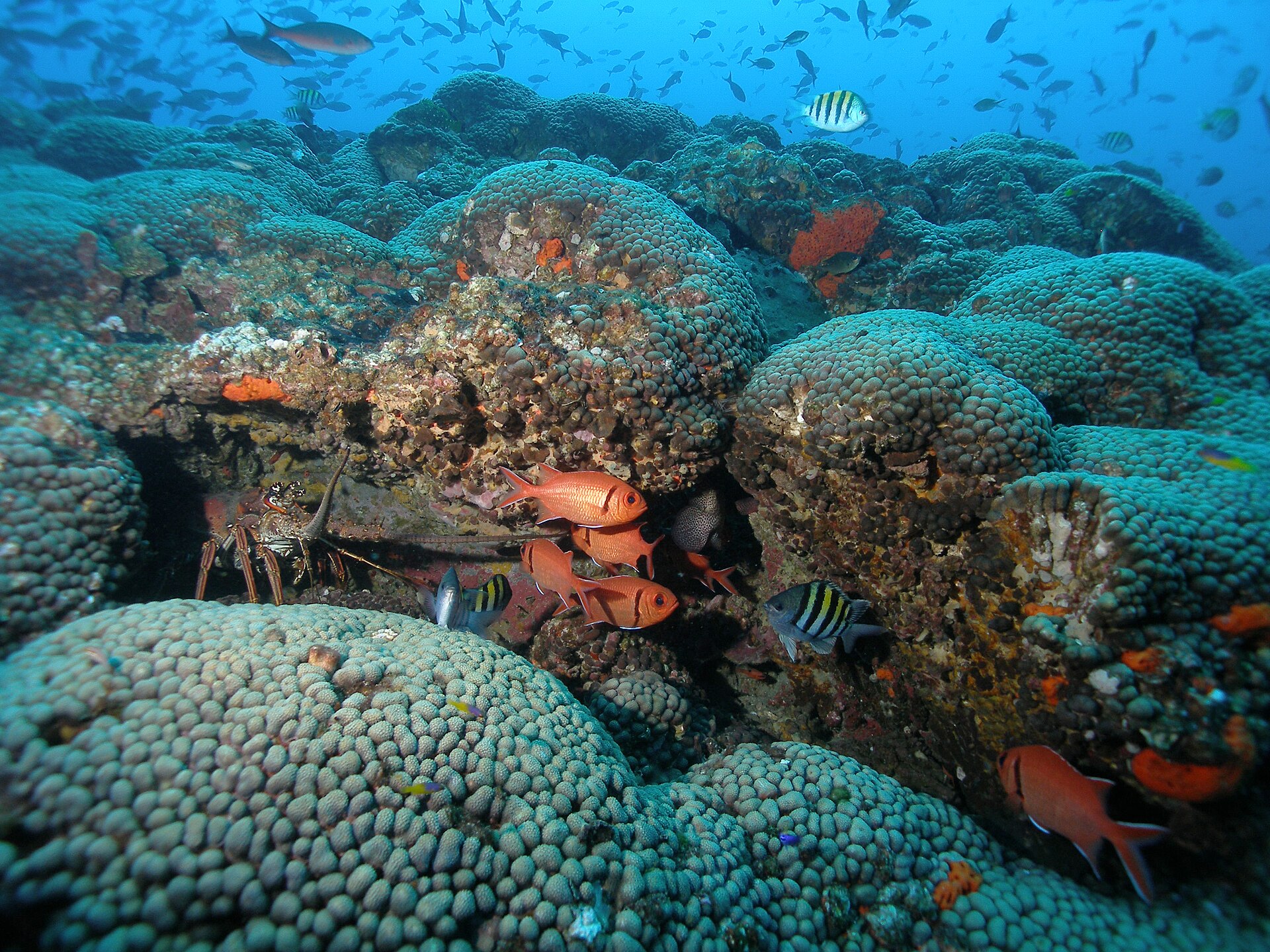
Healthy coral reefs are noisy places, full of snapping shrimp, grunting fish and crackling sounds. Coral and fish larvae drifting in the open ocean seem to use these sounds to find a place to settle. Three new studies tested whether we can use that behavior to support reef restoration.
Corals in the Caribbean
Nadège Aoki and colleagues placed larvae of grooved brain coral, a reef-building species, at six sites on two reefs in St. Croix, U.S. Virgin Islands, and played recordings of active reefs for 72 hours. In static cups of seawater, settlement was 1.79 times higher at the sites with reef sound. Larvae kept in flow-through mesh tents barely responded to the playback, but settlement differed tenfold between the two reefs, a reminder that sound is only one of many cues corals use.
Corals and fish in Hawaii
In Kāneʻohe Bay on Oʻahu, a team from Scripps Institution of Oceanography played healthy reef sounds from an underwater speaker every night for two weeks. Coral settlement was highest on artificial structures closest to the speaker, especially those with crevices and a coating of living bacterial “reef ink”. A second study used custom underwater cameras and found that the site with the speaker attracted 4 to 14 times more fish larvae than a control site with a silent speaker, and the result held when the two speakers were swapped.
Why this matters to me
Underwater acoustics is becoming a bigger part of my own research, and these results show why. Sound is not a magic fix, and the Caribbean study shows that the effect depends on conditions. But combined with good habitat, acoustic enrichment could become a practical tool to speed up the recovery of damaged reefs.
Read the study: Aoki, N. et al. (2026). Effects of acoustic enrichment on settlement of a critically endangered broadcast spawning coral. Scientific Reports 16, 18681. doi.org/10.1038/s41598-026-54431-1. The Hawaii studies by Thode et al. (Communications Biology) and Boulais et al. (Scientific Reports) are summarized by UC San Diego.
Cover photo: National Marine Sanctuaries, Wikimedia Commons, Public domain
.jpg)